
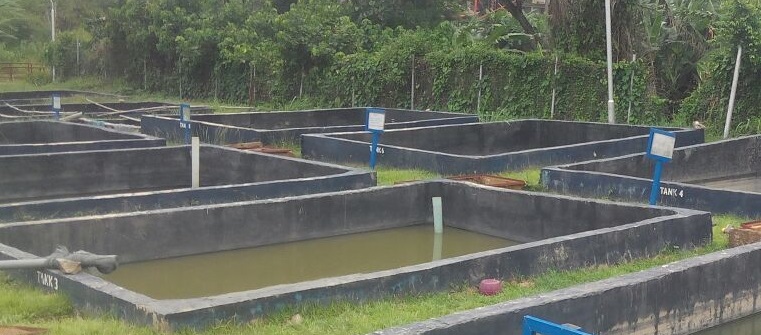
Homestead Fish Pond: An Extra Source of Income
This is any unit of concrete, earthen, metallic, plastic, fibre, glass receptacle sited within or in the vicinity of a household primarily for rearing fish and or its related kind.
FACTORS FOR SUCCESSFUL FISH FARMING
- Be committed. Aquaculture requires commitment for success.
- Recognize that fish are live animals and needs to be treated as such.
- Start small to reduce the risk of loss while learning about aquaculture.
7 REQUIREMENTS FOR HOMESTEAD FISH POND ESTABLISHMENT
- CAPITAL: This is the first thing to be taken into consideration for in every business, money is very essential. Without money, the business cannot take off. The capital aspect of it depends on the size of the business.
- LAND SPACE (SUITABILITY): Land space (suitability): It must be a household in medium density urban area reasonable land space and sufficient water supply or household in very low density rural areas with unlimited land space and regulator water supply.
- RECEPTACLE: i. Pond – earthen ii. Tank – Concrete, plastic, glass or collapsible vat.
- WATER SUPPLY: Water is perhaps the most fundamental aspect of fish farming because without suitable water supply, the farm can never be successful. Therefore, good water quality is a must to grow fish. Reasons for good water quality
- It is the home for fish
- It provide oxygen and food for fish
- It is a medium for waste discharge such as carbon dioxide, nitrogenous wastes and also excreta. NOTE: Frequent water change: you can notice the accumulation of waste through foul smell emanating from the water and colour changes. When you notice this you have to drain the water off completely and replace with fresh one.
Source of water:
Borehole, Rain water, Well water or Tap water are all good source of water for fish culture.Note; Before tap water can be used, it has to be expose to atmosphere i.e. Air for at least 48 hours before use because of the presence of chlorine in tap water which is detrimental to fish health.
- FISH: Handling: sourcing, selection, transportation, sorting, stocking and harvestingGuidelines for sourcing fish
It is advisable to source fish for culture using the following guidelines:
- It must be obtained from an existing farm with hatchery and known history
- It must not be from the wild for a beginner
- Proximity of the farm to avoid stressful transportation
- Pedigree of the fish Selecting fish for culture
The criteria used in selecting fish for culture includes:
- Fast growth rate with minimum time to grow (4-6 months)
- Ability to adapt to crowded condition
- Flavour, taste and texture acceptable to potential consumers
- Easy to handle, sample and harvest
- It must accept artificial feed easily
- It must be hardy to stressful, disease and environmental condition
- It must be popular and highly marketable
- Easy to breed in captivity producing large number of eggs whose larvae, fry and fingerlings survives under artificial and controllable conditions
- High feed conversion efficiency.
Cultivable specie:
- African mud catfish – clarias gariepinus – Eja aro
- Giant catfish – heterobranchus bidorsalis – Aro gidigba/Aso
- Slap water – heterotis niloticus – Agbadagiri
- Tilapia – Oreochromis niloticus – Epiya
Fish transportation
Fish transportation is often done first thing in the morning or late in the evening when the temperature is low. This is done in order to reduce stress, because loss during transportation affects profit margin severely.
Factors affecting transportation
- Specie
- Age and size
- Water temperature
- Length of time of transportation
- Means of transportation
- Nature of receptacle
Method of transportation
- Tank
- Plastic bags
- Plastic jars, bucket and drums
Sorting: This is a means of separating the shooters (bigger ones) from the smaller ones, this must be done regularly in order to avoid cannibalism, i.e. Preying on each other.
Stocking: This is a means of releasing into pond an adequate number of selected (desirable) fish species which are of proper and uniform sizes for culture purposes.
Health
Factors that affect the health of fish include;
- Disease
- Predation
- Cannibalism
Disease: change the water frequently in order to avoid disease outbreak, apply salt to the water whenever the water is changed to prevent fish bacterial infection.
Predation: in case of earthen pond, all round netting or overhead netting is done to prevent the pond from predators such as snakes, frog, stray birds e.t.c. while shed is erected over tanks to prevent it from direct sunlight and predator.
Cannibalism: This is a situation whereby the fish prey on each other, in order to avoid this, regular sorting is required.
- FEEDING
When fish are removed from their natural environment to an artificial one, enough food must be supplied in order to enable them grow. Feeding is one of the important factors of fish production, without adequate feeding optimum result can never be achieved.
However, before you start feeding you must allow the fish to acclimatise with the new environments i.e. leave them for twelve (12 hours) hours before feeding. feeding is carried out by process known as broadcasting i.e. feed are thrown by hand into the pond either on one sport in the pond or over a wide area. Broadcasting is a good method of feeding fish because the fish farmer can observe the behaviour of the fish.
Feeding is done two to three times daily and it must be done to satiation.
Types of feeds
- Artificial feed (pelletized feed)
- Natural feed (earth worm, toad or frog larvae, maggot, zooplanktons, phytoplanktons.
- HARVESTING AND MARKETING
Fish harvesting could be partial or complete and it is done by draining out the water, crop the fish with drag net, sort into sizes, count and weigh.The bigger ones which is the table size is sold at the higher price which is between N550 and N600 per kilogram for the hoteliers or consumers, while the smaller ones can be processed into smoked fish, packaged for sale.
Bukola Akinjo is an Aquaculture Trainer at The Ark Shore Konsults (T.A.S.K.). She holds a Bachelor’s degree in Fisheries Management from the Federal University of Technology, Akure, Nigeria.


Leave a Reply
Want to join the discussion?Feel free to contribute!